Reach out to inquire further.

What Is a Village to You?
"It takes a village" is not about luck—it's about intention. What a real village looks like for modern families, and how to start building one.
GENERAL
Chelsea Larsen
3/9/20265 min read
What Is a Village to You?
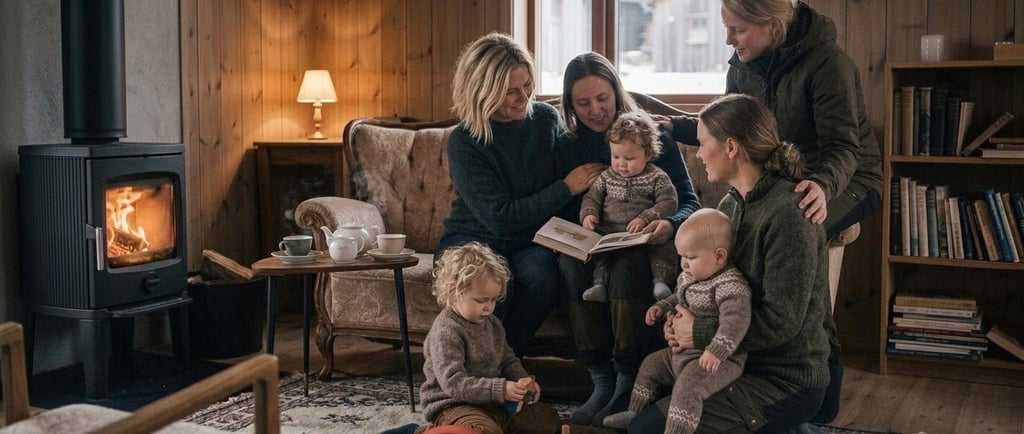
Everyone says it. "It takes a village." We say it at baby showers and in parenting forums and in the exhausted text threads between friends who are all running on four hours of sleep. We say it like a mantra, like a prayer, like a joke that is not really a joke.
But I have been thinking about this phrase for years—long before I founded Kin & Company—and I have come to believe that most of us are saying it wrong. We say "it takes a village" as if the village is something that happens—a thing we stumble into, a lucky accident of geography and timing. As if some parents get a village and others do not, and the difference is just fortune.
I do not believe that. I believe a village is something you build. And the kind of village that actually holds you—that actually makes the difference between drowning and thriving—is not the accidental kind. It is the intentional kind.
The Village We Lost
There was a time when the village was not a metaphor. It was literal. You lived near your parents, your siblings, your cousins, your neighbors who had known you since you were a child yourself. Someone was always around. Someone had already raised four kids and could tell you that the rash was nothing and the fever was worth a call. Someone could hold the baby while you showered, not as a favor but as the normal texture of daily life.
That village is gone for most of us.
We live in cities hundreds of miles from family. We move for jobs, for opportunity, for the kind of life that requires leaving the place we came from. We build beautiful homes and fill them with carefully chosen things and then close the door and discover that we are profoundly, specifically alone with a newborn who does not sleep and a partner who is also falling apart.
The isolation of modern parenthood is not a personal failure. It is a structural one. We dismantled the village and replaced it with nothing, then told parents they should be able to do this alone.
They cannot. No one can.
What "Village" Actually Means
When I say "village," I do not mean a crowd. I do not mean a bustling neighborhood of open doors and casserole deliveries. I mean something smaller and more powerful.
A village, to me, is a small circle of people who hold your family with consistency, competence, and genuine care. People who know your child's name and their bedtime and which song calms them down. People who do not need to be managed, directed, or reminded—because they are invested enough to pay attention.
A village is not accidental proximity. It is intentional trust.
For some families, the village includes grandparents, aunts, close friends. For others—especially the families I work with, who have often relocated far from family, who work demanding careers, who value privacy and intentionality—the village must be built from scratch. And that is not a lesser village. It is often a better one, because every person in it was chosen for a reason.
Building the Intentional Village
I built Kin & Company to be the starting point of that intentional village. Not the whole village—no single company can be that—but the foundation.
When I work as a caregiver with a family, I am not filling a position. I am introducing a person who will become part of the family's inner circle. Someone who will see them at their most vulnerable and hold that space with grace. Someone who will know the house, the rhythms, the child's particular way of asking for comfort. Someone who stays.
The staying is the part that matters most. A village is not a rotating cast of helpers. It is the same people, day after day, building a shared understanding so deep that words become unnecessary. The caregiver who sees the baby rubbing their eyes and starts the nap routine without being asked. The person who notices the parent is having a hard day and quietly takes on a little extra. That is village behavior. That is what consistency makes possible.
The Villages I Have Seen
In my years of this work, I have watched families build villages in many different ways and settings. They look different from the outside, but they share the same qualities on the inside.
I have seen a family in Denver whose village is their Kin & Co caregiver, a postpartum doula who stayed on as a family friend, and a grandmother who flies in once a month. Three people. That is it. And that family thrives because those three people communicate, care genuinely, and show up with consistency.
I have seen families whose village is their nanny, their pediatrician, a lactation consultant they still text at midnight, and one neighbor who drops off soup. No family nearby. No childhood friends in the city. A village built entirely from intention—and it holds.
I have seen a single mother in Iowa whose village is her Kin & Co caregiver and her therapist. Two people who hold her steady while she holds her baby. Two people who never judge and never leave. That is a village. It does not need to be large. It needs to be real.
What I Want for You
I want you to stop feeling guilty that you do not have a village and start building one.
Building a village is not a sign of inadequacy. It is a sign of wisdom. It means you have recognized that parenthood—especially in the first years—requires more hands, more hearts, and more presence than any one or two people can provide alone. And it means you are willing to invest in the kind of support that actually works: consistent, personal, grounded in trust.
Your village might be three people. It might be five. It does not need to look like anything Instagram would recognize. It needs to be made of people who know your child, who respect your values, who show up when they say they will, and who stay long enough for trust to take root.
If you are reading this and thinking, I do not have that. I do not know where to start—that is exactly why Kin & Company exists.
I cannot build your whole village. But I can help you find the first person in it: a caregiver so extraordinary that the rest starts to fall into place. Because when you have one person you truly trust with your child, with your home, with the hardest hours of your day—everything changes. The fog lifts. The overwhelm softens. The space opens up for you to be the parent you want to be, not just the parent who is surviving.
That is what a village does. Not because it is big, but because it is real.
What is a village to you? I would love to hear. And if you are ready to start building one, I am here. Reach out to inquire further.