Reach out to inquire further.

Montessori at Home: 6–12 Months—Supporting Crawlers and Early Explorers
Montessori for 6-12 month olds—how to adapt your prepared environment for crawlers with treasure baskets, low shelves, and freedom to explore safely.
MONTESSORI IN THE HOME
Chelsea Larsen
12/20/20256 min read
Montessori at Home: 6–12 Months—Supporting Crawlers and Early Explorers
I love this stage. There is nothing quite like watching a six-month-old discover that they can move—really move—with purpose. One day they're reaching; the next they're rolling across the room toward the wooden rattle that caught their eye. Within weeks, they're crawling, pulling up on furniture, tasting the world with every sense they have. If you're thinking about montessori 6 to 12 months, you're thinking about one of the most remarkable developmental windows your child will ever experience.
The prepared environment that served your newborn so beautifully now needs to evolve. The movement mat and visual mobiles give way to low shelves, treasure baskets, and open floor space designed for a baby who is no longer content to observe—they want to explore. This guide covers every element of adapting your home for your crawler, from the activities that support their development to the honest conversation about baby-proofing the Montessori way.
If you're building on the [newborn prepared environment](/blog/montessori-for-newborns-prepared-environment), this is the natural next chapter. And if you're coming to Montessori for the first time with a baby in this age range, you'll find that the principles translate immediately—and the results are extraordinary.
The Explorer Stage—What's Happening Developmentally
Between six and twelve months, your baby is in what Maria Montessori called the sensitive period for movement. Their body is learning to do what their mind has been preparing for since birth: move through space with intention and purpose.
This shows up in a cascade of physical milestones—sitting unassisted, crawling (forward, backward, sideways, in circles), pulling to stand, cruising along furniture, and for some babies, those first astonishing independent steps. But the developmental explosion isn't only physical. Your baby is also building object permanence, understanding cause and effect, developing their pincer grasp, and beginning to comprehend language long before they can speak it.
What does this mean for the prepared environment? It means your home needs to say yes. The montessori crawling baby needs space to move, objects to explore, and the freedom to follow their own curiosity without constant redirection.
Adapting the Prepared Environment for Crawlers
What Montessori activities for a 6 month old? At 6 months, Montessori activities focus on supporting your baby's emerging mobility. A treasure basket filled with natural objects, low open shelves with 3–4 rotating toys, and an uncluttered floor space for crawling exploration form the foundation of a prepared environment for this age.
The Treasure Basket
The treasure basket is one of my favorite introductions for this age—a concept developed by child development pioneer Elinor Goldschmied that aligns perfectly with Montessori principles. Take a sturdy, low-sided basket and fill it with 10–15 objects made from natural materials: a wooden egg, a small metal whisk, a silk scarf, a smooth river stone, a large cork, a short length of chain, a cotton flannel square, a small natural-bristle brush.
The objects should vary in weight, temperature, texture, and size (always large enough that they can't be swallowed). Your baby sits beside the basket—or crawls to it—and explores each object with their hands, mouth, eyes, and ears. There is no right or wrong way to use a treasure basket. There is only exploration, and it is endlessly fascinating to watch.
Low Open Shelves
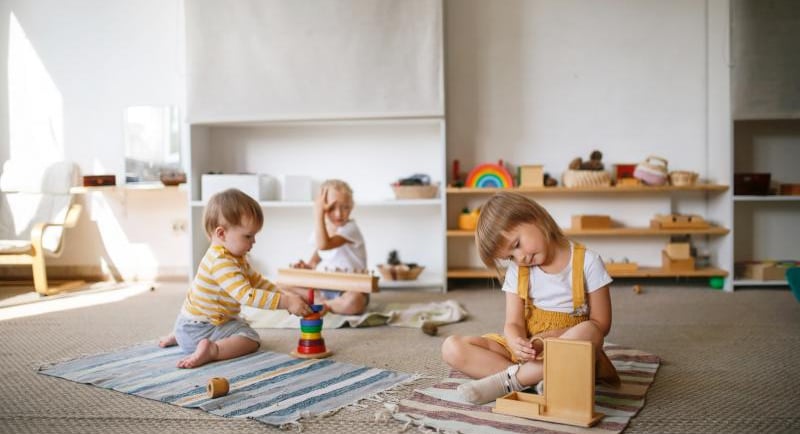
This is the stage where low open shelves become the centerpiece of your baby's montessori play space. Choose a sturdy shelf that sits at your baby's eye level when they're sitting or crawling—no higher than about 12 inches off the ground.
On the shelf, place three to four activities, each on its own small tray or basket. For a baby in this age range, that might include:
- An object permanence box (a simple wooden box with a hole in the top and a tray where the ball reappears)
- A set of stacking rings in natural wood
- A small basket of nesting cups
- A single-piece puzzle with a large knob
When should baby start Montessori toys? Your baby is ready for Montessori toys and materials as soon as they can sit and reach with intention—typically around five to six months. Start with the treasure basket and one or two shelf activities, and add more as their concentration and mobility develop.
Rotate these activities every week or two, observing which ones capture your baby's attention and which have been mastered. The goal is not variety for its own sake—it's offering just enough novelty to sustain engagement without overwhelming your baby's developing ability to concentrate.
Movement-Friendly Furniture
Arrange your furniture to support your baby's physical development. Low, sturdy surfaces for pulling up. Clear pathways for crawling. A small bar mounted on the wall at the right height for cruising. Think of your living space as a landscape your baby is learning to navigate—and arrange it so the journey is both safe and rewarding.
Montessori Activities for 6–12 Months
Beyond the treasure basket and shelf work, this stage introduces the very beginnings of practical life—those everyday activities that build independence, coordination, and a sense of belonging in the family.
First Practical Life
- Drinking from an open cup. Around six months, you can introduce a small, open cup (a shot-glass-sized ceramic or stainless steel cup works beautifully) with a tiny amount of water at mealtimes. Will your baby spill? Absolutely. Will they learn to drink independently far earlier than most parents expect? Also absolutely.
- Self-feeding. Offer small pieces of food on a low tray or plate, allowing your baby to pick up food with their developing pincer grasp. This isn't just nutrition—it's fine motor development, hand-eye coordination, and the earliest expression of autonomy at the table.
Sensory Exploration
Fill your baby's world with natural sensory experiences. A basket of pinecones to examine. A bowl of water to splash during bath time. The texture of grass under their palms during outdoor time. Montessori activities for six-month-olds and beyond don't require expensive materials—they require attention to the sensory richness of the real world.
Baby-Proofing the Montessori Way
How to baby proof a Montessori home? The Montessori approach to baby-proofing is about creating freedom within safe limits—not about removing everything within reach, but about making everything within reach safe and worthy of exploration.
This means:
- Secure what's dangerous. Outlet covers, furniture anchors, cabinet locks on spaces that hold cleaning supplies or sharp objects, gates at stairways. These are non-negotiable safety measures.
- Leave accessible what's appropriate. A low shelf with your baby's materials. A drawer in the kitchen with safe utensils they can explore. Books on a low shelf they can pull down and page through. Montessori baby-proofing trusts the child with real objects in a safe context.
- Accept some mess. A baby who is free to explore will pull things off shelves, scatter toys, and taste everything. This is the work of this age. It's not disorder—it's development.
The principle I share with every family: if you find yourself saying "no" more than "yes" in a given space, the environment needs adjusting—not the baby.
The Floor Bed Transition
Many families in this age range begin considering the transition from bassinet to a true Montessori floor bed—a firm mattress placed directly on the floor in a fully baby-proofed room, allowing your baby the freedom to get in and out of bed independently.
The timing varies from child to child, but most families I work with make this transition somewhere between eight and fourteen months, when their baby is mobile enough to safely navigate getting on and off a low mattress. Some families embrace the floor bed earlier; others wait until their child is walking confidently.
There's no single right answer—only the answer that feels right for your family, your baby's development, and your home. For a detailed walkthrough of the transition, including room setup and safety considerations, explore the [Montessori floor bed guide](/blog/montessori-floor-bed-guide).
Growing Into the Next Stage
Watching your baby explore the world is one of parenthood's great joys. These months between six and twelve are fleeting and extraordinary—a time when every day brings a new capability, a new discovery, a new expression of your baby's emerging personality.
The prepared environment you create now isn't just supporting today's development. It's building the foundation for the [toddler prepared environment](/blog/montessori-for-toddlers-12-24-months) that comes next—a stage where independence explodes and the principles of Montessori truly come alive in daily life.
If you'd like a caregiver who nurtures your baby's curiosity with Montessori expertise—someone who knows exactly when to rotate the shelf activities, when to introduce the open cup, when to step back and let your baby's own determination carry them across the room—I'd love to connect. Book a Discovery Call! (contact urlt).
For the full age-by-age journey, explore my [Complete Guide to Montessori at Home](url).